
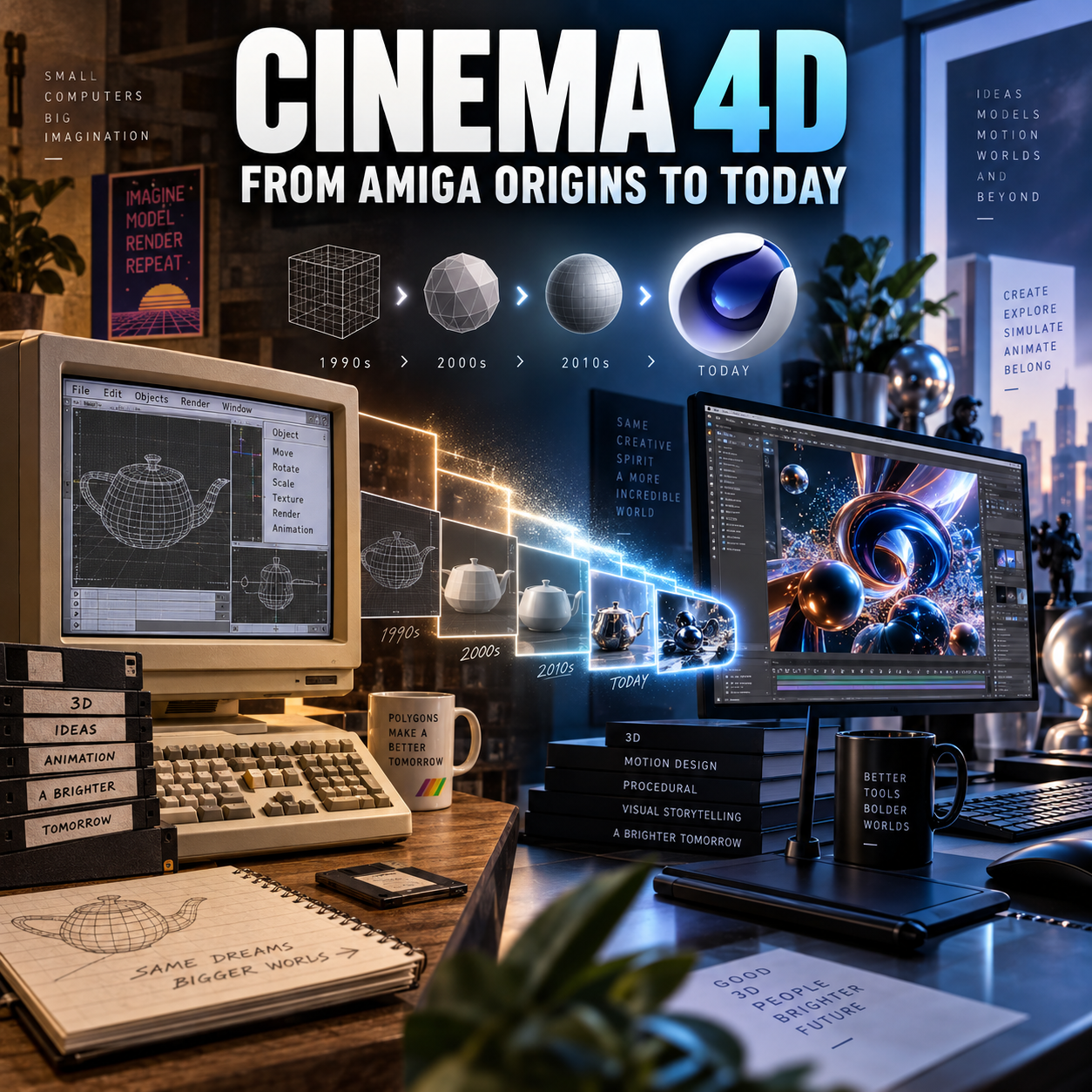
Timeline
1990 — Christian and Philip Losch win Maxon's Kickstart programming competition with their Amiga ray tracer.
1991 — FastRay is released.
1993 — Cinema 4D V1 launches on Amiga.
1994 — Cinema 4D V2.
1995 — Cinema 4D V3; cross-platform development begins.
1996 — Cinema 4D V4 reaches Windows, Macintosh, Alpha NT and Amiga.
1997 — Cinema 4D V4.2 becomes the final Amiga version; XL V5 pushes into professional production.
2000 — Cinema 4D XL V6 and BodyPaint era.
2019 — Maxon acquires Redshift.
2020 — Maxon and Red Giant combine.
2022 — ZBrush officially joins Maxon.
1991 — FastRay is released.
1993 — Cinema 4D V1 launches on Amiga.
1994 — Cinema 4D V2.
1995 — Cinema 4D V3; cross-platform development begins.
1996 — Cinema 4D V4 reaches Windows, Macintosh, Alpha NT and Amiga.
1997 — Cinema 4D V4.2 becomes the final Amiga version; XL V5 pushes into professional production.
2000 — Cinema 4D XL V6 and BodyPaint era.
2019 — Maxon acquires Redshift.
2020 — Maxon and Red Giant combine.
2022 — ZBrush officially joins Maxon.
From FastRay to Cinema 4D: The Remarkable Story Behind One of 3D’s Most Important Creative Tools
Today, Cinema 4D sits at the centre of motion design, 3D animation, product visualisation, architectural imagery, VFX and digital art.
Open the latest version and you’re working with procedural modelling, simulations, particles, MoGraph, sophisticated materials, GPU rendering and an ecosystem that extends through Redshift, ZBrush and the wider Maxon family.
But Cinema 4D did not begin in a major Hollywood studio. It did not begin with hundreds of developers. And it certainly did not begin with GPUs, real-time rendering or cloud render farms.
Its story begins with an Atari ST, the Commodore Amiga, a computer magazine, two brothers and a home-built ray tracer. And that makes its history particularly fascinating.
Before Maxon was a 3D software company
The story begins in Germany in the mid-1980s.
Harald Egel, Uwe Bärtels and Harald Schneider were students when they entered the rapidly expanding world of personal computing. After acquiring an Atari ST, they began writing about the machine and its programming environment.
In January 1986, the first issue of ST-Computer appeared. A sister publication called Kickstart, focused on the Commodore Amiga, followed later that year. These magazines became part of the foundation from which Maxon would eventually emerge as a software company.
This was an extraordinary period in computing. The graphical workstation was no longer something that existed exclusively inside universities, engineering departments or enormous corporations. Machines such as the Atari ST and Commodore Amiga were beginning to place serious graphical capabilities onto the desks of enthusiasts.
And among those enthusiasts were two brothers: Christian and Philip Losch.
Two brothers start experimenting with ray tracing
In the late 1980s, Christian and Philip Losch began developing their own ray-tracing software on the Commodore Amiga.
Consider the environment they were working in; There was no YouTube, No Stack Overflow, No online documentation, No Discord community, No thousands of tutorials explaining ray tracing, shaders, reflections or 3D mathematics.
Philip Losch has since described going to libraries, requesting technical papers on microfilm, waiting weeks for them to arrive, studying them, taking notes and returning home to experiment with the ideas themselves.
That detail alone makes the story remarkable. Today, an artist can search for a Cinema 4D technique and have twenty tutorials open within seconds. These developers were effectively reverse-engineering their own education.
The programming competition that changed everything
Around 1990, the Losch brothers submitted their ray tracer to a programming competition run by Maxon's Amiga magazine, Kickstart.
They won.
That competition entry would become the foundation of something much bigger. Historical accounts trace Cinema 4D directly to this early ray-tracing project.
There is also a wonderful piece of folklore surrounding its creation: the brothers reportedly debated whether to create a spreadsheet or a ray tracer and ultimately chose the ray tracer. Whether every detail of that anecdote has survived history perfectly is less important than what happened next.
Fortunately for generations of 3D artists, the ray tracer won.
1991: FastRay arrives
In 1991, Maxon released the Losch brothers' technology for the Commodore Amiga under the name FastRay. This is the direct ancestor of Cinema 4D.
Early FastRay was understandably primitive compared with modern 3D software. The project evolved to include a graphical editor known as FRED — FastRay Editor — although the familiar interactive 3D viewport we now take completely for granted had not yet arrived. Historical records describe FastRay scenes originally being defined through data rather than the sophisticated graphical environment modern artists expect.
Think about that for a moment. Today we instinctively orbit around our scenes, drag objects through space, adjust materials interactively and watch GPU renderers respond almost instantly.
Back then, simply generating the image was the achievement.
1993: Cinema 4D is born
Then came the pivotal moment. In 1993, the project evolved into Cinema 4D V1, released for the Commodore Amiga. FastRay had become Cinema 4D. The name that millions of artists now recognise had arrived. And the Amiga remained Cinema 4D's home for the next several versions.
Cinema 4D V2 followed in 1994, with V3 arriving in 1995.
What I find particularly interesting about looking at these old interfaces is that you can already see the beginnings of the philosophy that still defines Cinema 4D today; Objects. Views. Coordinates. Hierarchy. Scene construction.
The graphics may look ancient, but the fundamental problem being solved is exactly the same one we face today:
How do you give an artist an understandable interface for constructing an imaginary three-dimensional world?
The Amiga disappears — Cinema 4D survives
Then the platform underneath Cinema 4D began disappearing. Commodore went bankrupt in 1994, putting the long-term future of the Amiga ecosystem in doubt. For a software company tied heavily to one platform, this could easily have been the end of the story.
Instead, Maxon began rebuilding Cinema 4D around an operating-system-independent architecture. By 1996, Cinema 4D V4 was available across Windows, Macintosh, Alpha NT and Amiga, and it introduced features including multiprocessing support. That decision may have been one of the most important in Cinema 4D's history.
Maxon wasn't simply porting an application. It was giving Cinema 4D a way to survive the death of the computer platform that created it.
1997: Goodbye Amiga. Hello professional production.
Cinema 4D V4.2 in 1997 became the final Amiga release. The same period saw the arrival of Cinema 4D XL V5, described in historical version records as the first production-level or "production-worthy" Cinema 4D release. From this point forward, Cinema 4D's ambitions became significantly larger.
It was no longer merely an interesting 3D package from the home-computer era. It was becoming a professional creative tool.
For younger artists who grew up with multi-core CPUs and RTX GPUs, it is difficult to appreciate just how different this world was. A scene that might render interactively today could once represent hours of computation.
Every optimisation mattered.
Every polygon mattered.
Every reflection had a cost.
Yet artists and developers were already chasing exactly the same goal we pursue today:
turning imagination into pixels.
From a ray tracer to an entire creative ecosystem
The next decade transformed Cinema 4D again.
BodyPaint 3D appeared around 2000, followed by tools including Dynamics, PyroCluster, Thinking Particles, MOCCA, Advanced Render and eventually the workflow that would make Cinema 4D particularly famous among motion designers.
MoGraph.
Cinema 4D steadily developed a reputation for something that remains central to the software today: combining sophisticated 3D capabilities with an unusually approachable workflow.
Maxon's own retrospective on Philip Losch describes that philosophy as a belief that powerful creative software should remain intuitive, encourage experimentation and ultimately serve the artist.
That philosophy arguably became Cinema 4D's greatest competitive advantage.
Maxon itself became something much bigger
The company evolved alongside the software.
Nemetschek became a major shareholder around the beginning of the 2000s, providing a much larger corporate foundation behind Maxon's development. Historical accounts document a 70% investment around 2000.
Then came a series of major expansions. Maxon acquired GPU renderer Redshift in April 2019.
Later that year, Maxon and Red Giant announced plans to merge, with the combination completing in 2020.
In late 2021 Maxon announced the acquisition of Pixologic, the creators of ZBrush, with the transaction completed in January 2022.
The little ecosystem that once revolved around an Amiga ray tracer had grown into a creative technology portfolio spanning:
Cinema 4D. Redshift. ZBrush. Red Giant. Rendering. Sculpting. Motion graphics. VFX.
That is quite a journey.
And Philip Losch is still there
Perhaps the most remarkable part of the story is the continuity behind it.
More than three decades after he and his brother began experimenting with their Amiga ray tracer, Philip Losch remains part of Maxon's senior technical leadership.
Maxon still credits Philip and Christian Losch with creating the technology that became Cinema 4D, tracing the project back to 1989.
There aren't many major creative applications where someone involved at essentially version zero remained connected to its evolution more than three decades later.
That continuity matters.
Software is code, but great creative software also contains ideas about how people should interact with machines.
Those ideas can survive hardware generations, operating systems and entire technological eras.
Video / archival material
Amiga - Cinema 4D (YouTube) — footage of Cinema 4D running on a real Amiga. I couldn't load the page to confirm which version it shows, so check the description.
Maxon: Philip Losch and the invention of Cinema 4D — Maxon's own written retrospective with Losch's first-hand recollections (text, no video).
Internet Archive: Amiga Plus Maxon Cinema 4D (1998) — a preserved ~350 MB CD-ROM ISO of Cinema 4D V4 for Amiga. You could run this in an Amiga emulator (WinUAE/FS-UAE) if you want to touch the real thing.
aescripts: Working with Cinema 4D V4 from 1998 — a modern walkthrough of that vintage version.
The Toolfarm piece notes original FastRay interface footage (in German) exists on a French Cinema 4D YouTube channel, but doesn't link it directly.